‘Proximity’ and Power: The Ekurhuleni Blue Lights Scandal That Refuses to Fade
 Viable News Team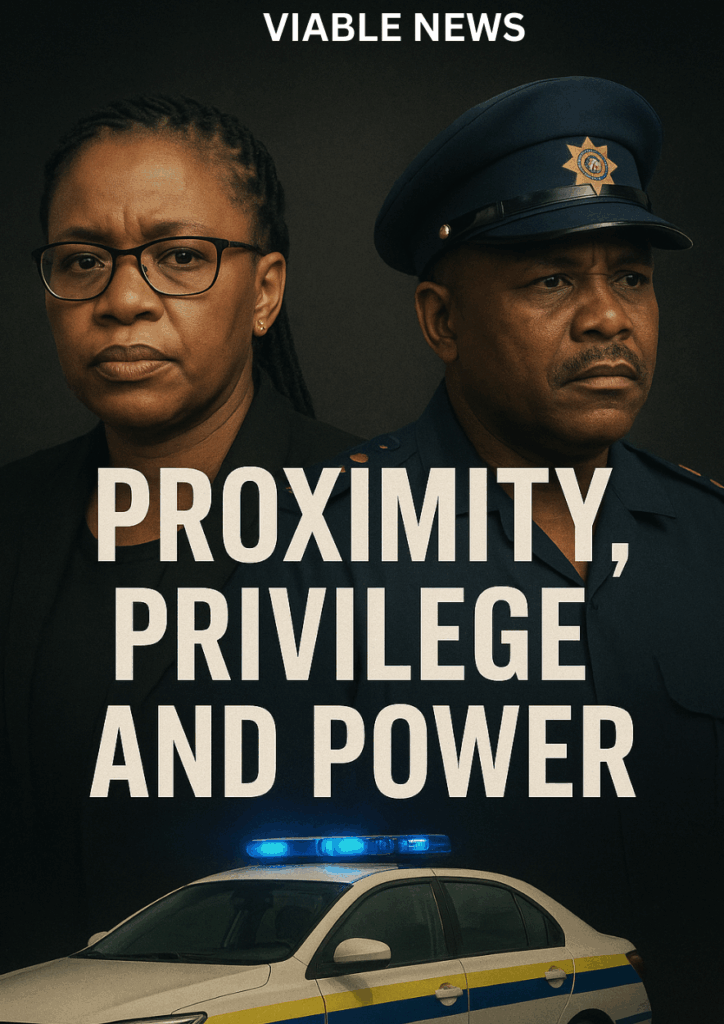
The corridors of the City of Ekurhuleni have once again been thrown into the spotlight, as disturbing allegations of political protection, administrative manipulation, and abuse of power dominate testimony before the Madlanga Commission. At the heart of the unfolding controversy lies a complex relationship between former city manager Imogen Mashazi and senior metro police officer Julius Mkhwanazi, whose alleged misuse of authority to benefit businessman Vusimuzi “Cat” Matlala has raised calls for a far-reaching investigation.

The controversy, which began as a seemingly isolated disciplinary issue within the Ekurhuleni Metro Police Department (EMPD), has widened into a broader reflection of how proximity between powerful officials can corrode institutional accountability. Testimony from former senior officials has revealed a troubling culture of intimidation, favouritism, and bureaucratic paralysis one that shielded certain individuals from scrutiny while eroding public trust in municipal governance.

At the centre of the scandal is Mkhwanazi, who, as Deputy Chief of the EMPD and former head of Specialised Services, allegedly authorised the illegal fitting of police-style blue lights on vehicles owned by Matlala and his private security firm, CAT VIP Security. The use of such lights is reserved by law for official law enforcement vehicles under the National Road Traffic Act, making their use by a private entity not only unlawful but deeply symbolic of a power imbalance where the lines between state authority and private interest blur dangerously.

Despite repeated warnings from internal officials and a recommendation from the Independent Police Investigative Directorate (IPID) for disciplinary action, little was done for months. The delay, several witnesses claim, was no accident. Instead, it was the result of deliberate obstruction at the highest levels of city administration particularly from the office of then-city manager Imogen Mashazi.
During a dramatic hearing before the Madlanga Commission, former Ekurhuleni human resources official Xolani Nciza described Mashazi’s relationship with Mkhwanazi as a “proximity” that went beyond normal professional boundaries. “There was a proximity that needs to be investigated,” Nciza told the commission, adding that Mashazi appeared “deeply invested” in protecting the embattled police official. This so-called “proximity” allegedly extended to influencing internal disciplinary processes, silencing dissenting voices, and fast-tracking promotions within the EMPD.

According to several reports, disciplinary proceedings against Mkhwanazi stalled because internal witnesses refused to testify, fearing reprisals. Some claimed to have received veiled threats, while others described a culture where loyalty to senior officials was rewarded more than adherence to procedure. During the same period, more than fifty promotions within the metro police were reportedly pushed through in just a few months many without proper advertisement or vetting. The promotions, insiders allege, were designed to consolidate control and ensure silence.
The irregular use of blue lights was not a minor administrative infraction. In a country where blue-light convoys have long symbolised political privilege and police impunity, the idea that private vehicles linked to a businessman could masquerade as law enforcement units is profoundly unsettling. It not only compromises public safety but also represents the capture of state symbols by private interests.

Mashazi has publicly denied wrongdoing, insisting that her actions were guided by due process and not personal relationships. Yet her denials have done little to quell speculation. Former colleagues describe an environment where decisions regarding Mkhwanazi’s case were taken behind closed doors, often bypassing established protocols. “There was no transparency,” one insider told investigators. “Everything concerning that matter was handled as if it were a state secret.”
The Madlanga Commission has since become a focal point for understanding how local government structures can be manipulated by internal networks of power. What emerges from the testimonies is not merely a story of one official protecting another, but a system of mutual dependence a web of influence where accountability gives way to complicity. In that system, the term “proximity” becomes more than a metaphor for closeness; it becomes an operational principle of governance itself.
The implications for Ekurhuleni are profound. The municipality, one of South Africa’s largest metropolitan areas, manages billions in public funds and employs thousands of officials. Its ability to deliver services depends on the credibility of its leadership and the integrity of its institutions. Scandals of this nature corrode public faith in both. When disciplinary mechanisms are paralyzed, when whistle-blowers are silenced, and when the symbols of law enforcement are hijacked for private use, the very foundation of local democracy is shaken.

Experts have warned that unless there is decisive action including a full forensic investigation into Mashazi’s and Mkhwanazi’s relationship and the internal handling of the blue-light affair the scandal risks setting a dangerous precedent. If high-ranking officials can manipulate disciplinary systems with impunity, then the promise of clean governance in post-apartheid local administration becomes little more than rhetoric.
Civil society groups have since called for renewed oversight from both the Gauteng provincial government and the national Department of Cooperative Governance and Traditional Affairs. They argue that the scandal should serve as a test case for strengthening whistle-blower protections and ensuring that municipal disciplinary processes are insulated from political influence.
The City of Ekurhuleni, for its part, has promised to cooperate with all ongoing inquiries. Yet many observers remain skeptical. Without clear and transparent disciplinary action, the city’s assurances may ring hollow. As one former official remarked anonymously, “You can’t rebuild public trust with statements only with accountability.”
The Madlanga Commission continues to hear testimony, and more revelations are expected in the coming weeks. But already, the case has become emblematic of a deeper malaise within South Africa’s local governance: the fusion of proximity, privilege, and power.
Ultimately, the “proximity” between the city manager and the blue-lights cop may prove to be more than just a personal connection it may stand as a metaphor for the dangerous closeness between corruption and authority that continues to haunt South African institutions.
About the Author