A City on the Edge: Tshwane’s Sinkhole Crisis Threatens Homes, Business, and Stability
 Viable News Team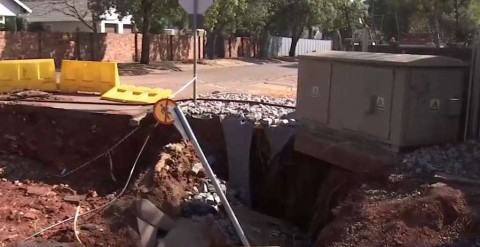
VALHALLA, GAUTENG – In the heart of South Africa’s capital city, a silent disaster is growing beneath the surface. Roads, homes, and businesses in parts of Tshwane are quite literally collapsing, as the metro grapples with an escalating sinkhole crisis that’s already left destruction in its wake.
For many in suburbs like Valhalla and Centurion, this is not a slow-moving disaster. It is urgent, present, and deeply personal. As streets vanish, properties crumble, and economic life stalls, residents are left asking a simple but devastating question: Where is the help?
The municipality estimates that there are currently over 65 active and serious sinkholes across the metro, a staggering figure that raises alarm about the city’s ability to manage basic infrastructure. Some are small and manageable. Others, however, have swallowed entire plots of land displacing families, disrupting small businesses, and severing crucial service lines.
And while local government works to mobilise resources and attention, the crisis is growing faster than the response.
Living on the Edge: Residents in Perpetual Uncertainty
In Valhalla, Centurion a normally quiet, middle-class suburb what once was a thriving residential and commercial area now resembles a patchwork of safety barriers, detours, and cracked pavement.
Residents like 57-year-old Amelia Mokoena, whose home has been under structural threat since late last year, describe daily life as a constant anxiety.
“Every time it rains, I don’t sleep. I walk around the house checking for cracks. You hear one noise at night and think the ground is opening,” she says.
Mokoena’s story is far from unique. Families across the metro have been forced to abandon their homes. Some have lost all their belongings, unable to return even to salvage valuables. Insurance coverage for geological damage is rare, leaving many without financial recourse.
Businesses, too, are struggling. In some parts of Centurion, road closures caused by expanding sinkholes have diverted traffic, crippled logistics, and cut off customers. For small enterprises already burdened by load shedding and rising operational costs, this has been the final blow.
Infrastructure Collapse or Natural Disaster? The Real Causes
At the heart of the issue is a combination of natural geological susceptibility and human neglect.
Much of Tshwane is built on dolomitic rock, a porous and reactive geological formation prone to dissolution when exposed to water. In areas with proper drainage and modern infrastructure, the risks are minimal. But in regions where pipes are old, leaking, or poorly maintained, the consequences can be devastating.
Experts warn that decades of underinvestment in infrastructure maintenance, coupled with increasing urban development, have created the perfect conditions for sinkholes to emerge.
A 2023 internal municipal report noted that several water and sewage lines across the metro had not been upgraded since the 1980s. Leaks from these decaying pipelines slowly erode the ground, creating hollow cavities that eventually collapse.
As rainfall and groundwater infiltration increase especially during the summer storm season the fragile surface gives way.
A Leadership Test for Mayor Dr. Nasiphi Moya
Facing mounting public pressure, Tshwane Mayor Dr. Nasiphi Moya has taken to the media to reassure residents that help is on the way.
In recent statements, Moya confirmed that discussions with National Government are ongoing, with the aim of securing emergency intervention and long-term support to address the scale of the crisis.
Initial repair estimates sit at R300 million, a figure the city admits it cannot meet alone. However, the mayor insists that the issue is not being ignored.
“We understand the severity of the situation. We are working with engineers, provincial counterparts, and national departments to coordinate a response,” Moya stated earlier this week.
Still, the city’s response is being criticized as too slow and disjointed. Activists and community leaders argue that while technical assessments and funding strategies are necessary, they do little to help residents already displaced or living in structurally compromised buildings.
The Economic Fallout: Can Tshwane Still Attract Investors?
The crisis arrives at a particularly delicate time for the City of Tshwane. In just a few weeks, on September 10th, the city will host its much-anticipated Investment Summit, a high-profile event aimed at securing R5 billion in fundingfor development projects.
The timing is unfortunate if not ironic.
While municipal leaders are preparing to pitch Tshwane as a destination for growth, opportunity, and international investment, local infrastructure is literally collapsing. For potential investors, the sinkhole crisis raises glaring red flags about governance, planning, and the long-term safety of their investments.
How can a city position itself as a gateway to economic progress when it cannot guarantee stable ground beneath its citizens’ feet?
Beyond the Holes: A Humanitarian Concern
Though much of the conversation has focused on technical and economic implications, the human cost of the crisis cannot be overstated.
Families are sleeping in cars. Children are pulled out of schools due to unsafe commutes. Elderly residents, some of whom have lived in their homes for decades, are now stranded in limbo unsure whether they will be relocated, reimbursed, or forgotten.
Community groups have stepped in where government has not, organizing food drives and temporary shelter efforts. But as weeks turn into months, goodwill is running dry.
The question many are asking now isn’t just when the city will fix the roads it’s whether it can rebuild trust.
What Needs to Happen Next?
Solving the sinkhole crisis won’t be easy. The process involves:
- Geotechnical surveys to assess underground stability
- Infrastructure upgrades, particularly water and sewage systems
- Land rehabilitation for already affected areas
- Community support, including temporary housing and financial aid
- Long-term urban planning reforms to prevent recurrence
All of these require money, expertise, and perhaps most importantly political will.
The city must act with urgency and transparency, keeping residents informed and engaged. Communication has been a major pain point, with many residents learning about dangerous sinkholes only after visible damage occurs.
Emergency intervention teams, disaster response protocols, and clearer reporting systems must become standard in high-risk zones.
A City at a Crossroads
Tshwane’s sinkhole crisis is more than just a geological event. It is a mirror reflecting the broader state of infrastructure management, governance accountability, and disaster preparedness in South Africa’s urban centers.
Mayor Moya and her administration have an opportunity and a responsibility to turn this crisis into a turning point. Not through slogans and promises, but through decisive, transparent, and community-centered action.
Because what lies beneath Tshwane is not just unstable ground. It is a warning and a test of leadership in the face of collapse.
About the Author