France Returns Skull of Beheaded Malagasy King in Historic Restitution
 Viable News Team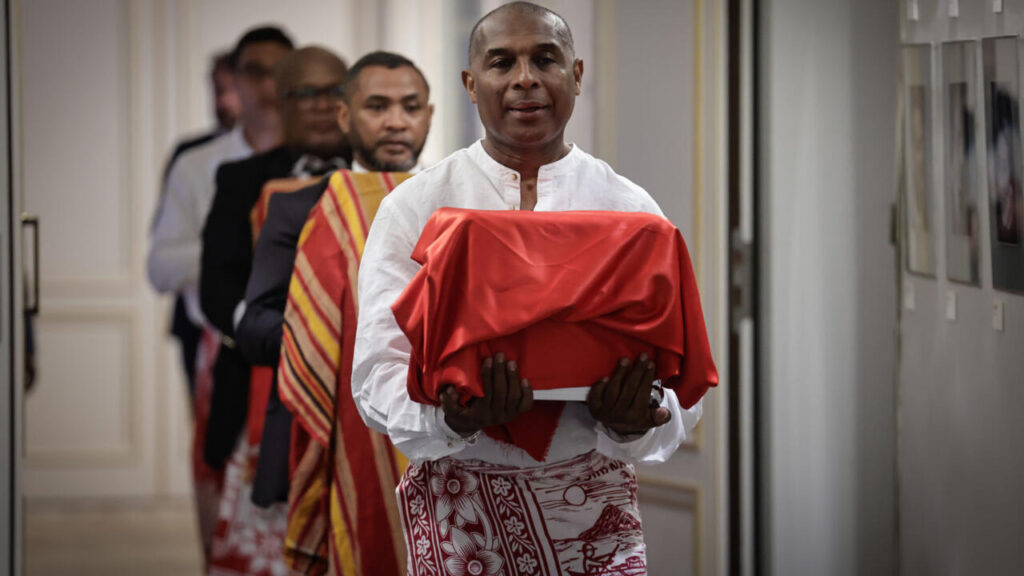
Antananarivo/PARIS – In a gesture hailed as both symbolic and profoundly healing, France has returned three colonial-era skulls to Madagascar, including one believed to belong to King Toera, a Malagasy monarch beheaded by French troops in 1897. The repatriation, announced on Tuesday, 26 August 2025, marks the first time France has returned human remains under a landmark restitution law passed in 2023.

The skulls, taken more than a century ago and stored for decades in Paris’s Musee de l’Homme (Museum of Mankind), were formally handed over to Malagasy officials in a solemn ceremony described as “historic” by both governments.
A Wound That Lasted 128 Years
For Madagascar, the return carries immense symbolic weight. King Toera, a ruler of the Sakalava people, was captured and executed by French colonial forces during a bloody crackdown in 1897. His skull was seized as a war trophy and transported to France, where it joined hundreds of other human remains collected from the island during the colonial era.
“These skulls entered the national collections in circumstances that clearly violated human dignity and in a context of colonial violence,” French Culture Minister Rachida Dati acknowledged during the handover.
Madagascar’s Minister of Culture, Volamiranty Donna Mara, described the moment as the closing of a painful chapter:
“Their absence has been, for more than a century 128 years an open wound in the heart of our island. Today, this gesture marks a new era of cooperation and reconciliation.”
Although scientists confirmed that all three skulls belonged to the Sakalava ethnic group, they cautioned that it could only be “presumed” that one of them was indeed King Toera’s.

France Reckoning With Its Colonial Past
Since taking office in 2017, French President Emmanuel Macron has taken steps to confront France’s violent colonial history. On a 2024 visit to Madagascar’s capital, Antananarivo, Macron sought “forgiveness” for what he called the “bloody and tragic” colonisation of Madagascar, which remained under French control until independence in 1960.
The restitution of King Toera’s remains reflects this broader reckoning. France has in recent years returned stolen artworks and human remains to African nations, including Benin and Senegal, but progress has often been slow due to restrictive legislation.
Until recently, each restitution required a special law passed by Parliament as was the case in 2002, when South Africa sought the return of the remains of Sara Baartman, known derogatorily in Europe as the “Hottentot Venus.”
The 2023 law on human remains, however, streamlined the process, making it easier for former colonies and Indigenous communities to reclaim their ancestors. Currently, around 30,000 specimens remain in the collections of the Musée de l’Homme a third of them skulls and skeletons. Countries such as Australia and Argentina have already submitted restitution requests.
France also passed a separate law in 2023 to accelerate the return of artworks looted from Jewish families during the Nazi era. A third proposed law, still under review, aims to enable the return of cultural objects acquired through colonial violence between 1815 and 1972.
Culture Minister Dati expressed hope that this broader restitution bill would be passed “quickly.”

A Step Toward Healing
For Madagascar, the skulls are set to return home on Sunday, where they will be laid to rest in a traditional burial. The ceremony is expected to be deeply symbolic, not just for the Sakalava people, but for the nation as a whole.
The return of King Toera’s skull is not only an act of restitution it is a moment of healing for a country still grappling with the scars of colonisation. It also sets a precedent for other nations seeking justice and dignity for their ancestors.

As both governments hailed the gesture as “historic,” it underscored a broader truth: the echoes of colonial violence may span centuries, but the path to reconciliation often begins with the simple act of giving back what was taken.
About the Author