Scrutiny Returns: Prenelan Subrayen Reported for Suspect Action After ODI Debut Triumph
 Viable News Team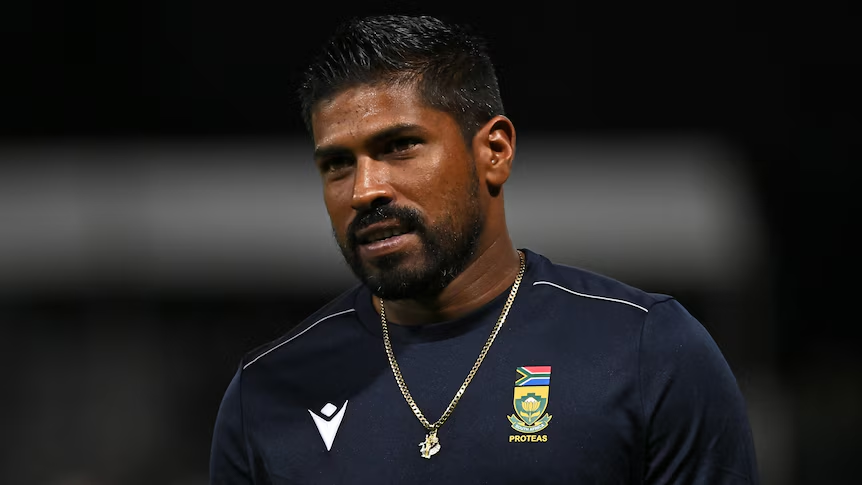
Johannesburg, South Africa – August 21, 2025
The elation of a convincing win quickly turned into a cloud of concern for the Proteas camp this week, as spinner Prenelan Subrayen fresh off his long-awaited One Day International debut was reported for a suspect bowling action following South Africa’s emphatic 98-run victory over Australia in Cairns.
For Subrayen, the moment was meant to be a milestone. At 31, the spinning all-rounder had finally broken through to make his ODI debut after years of perseverance, domestic excellence, and recently, a taste of Test cricket. His selection had been framed as both a reward and a necessity a tactical move to bolster South Africa’s spin options and to offer control and composure in the middle overs. And in that first outing, he delivered a tidy spell, returning figures of 1 for 46 in ten overs, including the crucial dismissal of Travis Head.
But behind the celebration, the familiar shadow of doubt has returned. Within hours of the match ending, the match officials submitted a report flagging concerns about Subrayen’s bowling action. The outcome: the spinner is now required to undergo independent biomechanical testing at an ICC-accredited facility within 14 days, as per international regulations.
For South Africa, it’s an unfortunate disruption at a time when consistency and clarity are desperately needed. The ODI series against Australia, still ongoing with matches in Mackay looming on Friday and Sunday, represents more than just another fixture it’s a chance for the Proteas to reclaim some momentum following a patchy T20I series loss and ongoing injury setbacks, including the absence of pace spearhead Kagiso Rabada.
Subrayen’s personal story, however, adds a much more complex dimension to this development. The scrutiny over his action is not new. In fact, it stretches back more than a decade, making him no stranger to this difficult and emotionally taxing process.
In December 2012, early in his career, Cricket South Africa placed him under formal rehabilitation after independent testing confirmed an illegal action. He worked his way through corrective processes, retraining his muscle memory, refining his release, and facing the mental toll of having his professional legitimacy questioned. He was cleared to return to bowling in January 2013, but his battle was far from over.
Over the following two years, Subrayen was reported on two separate occasions again, each time forcing him to pause, reassess, and rebuild. It wasn’t until March 2016 that he was finally cleared for good after comprehensive assessments at the National Performance Centre. Since then, he has quietly rebuilt his reputation, becoming one of the most reliable and skillful spinners in domestic cricket.
The road to international return was long and winding. Just two months ago, he achieved another career goal by making his Test debut against Zimbabwe in Bulawayo a moment that left him emotional and filled with pride. That performance seemed to signal a new chapter. The ODI debut in Cairns was meant to cement it.
Now, with his bowling action under the microscope again, Subrayen finds himself caught in a deeply personal and professional trial one that he has faced before, and one that very few players can truly relate to.
The mechanics of bowling, especially for spinners, are precise and complex. A slight deviation in arm angle, an unintentional wrist rotation, or even fatigue-induced alterations can all blur the line between legal and suspect. For those who have been previously flagged, every delivery comes with the weight of old fears. It is not just about execution it becomes a test of confidence, composure, and often, identity.
For Subrayen, this is a gut-punch, but not a knock-out. If his history tells us anything, it’s that he knows how to climb out from under scrutiny. He’s done it before, and with a stronger support structure now in place including an experienced national team setup and improved testing and coaching resources there’s every reason to believe he can do it again.
That doesn’t soften the blow to the team, however. In the short term, it puts head coach Shukri Conrad and his selectors in a bind. With Rabada sidelined and the spin department already stretched thin, the Proteas will have to rethink their balance and strategy heading into the remaining two matches in the series. Whether Subrayen will be available for selection remains uncertain, and his long-term availability could hinge on the outcome of the upcoming tests.
What remains clear is that this is a sport where second chances are earned, not given and Subrayen has already earned many. He has proven, again and again, that his love for the game is deeper than the setbacks. Each time his action has been called into question, he has responded with diligence and dignity, stepping back into the process with a quiet resolve that says more about his character than any statistic.
There will be questions. There will be commentary. But for now, Subrayen returns to a place of uncertainty—somewhere between redemption and repetition, between a future that felt just within reach and a past that refuses to fully let go.
The second ODI between South Africa and Australia is scheduled to take place in Mackay on Friday, August 22, and while the spotlight was supposed to be on the players hunting a series win, a portion of it will inevitably follow Subrayen both for what he’s already endured, and for how he handles the trial ahead.
And just like before, he’ll face it head-on. Quietly. Professionally. With the resilience of a man who refuses to let setbacks define his story.
About the Author